Common Mistakes in Kg to Stone Conversions and How to Avoid Them
A practical guide to accurate weight conversion for health tracking, BMI calculation, and everyday use.
Why Accuracy Matters in Kg to Stone Conversion
At first glance, converting kilograms to stone might seem like a minor arithmetic task — something you can dash off with a rough estimate and move on. But in practice, small conversion errors can snowball into significant inaccuracies, particularly when the numbers feed into health decisions, fitness goals, or medical assessments.
The BMI Connection
Body Mass Index (BMI) is one of the most widely used screening tools in both clinical and personal health settings. The NHS BMI calculator, like most medical tools worldwide, requires weight to be entered in kilograms. If you begin with a stone measurement and convert it incorrectly before plugging it into the formula, your resulting BMI figure could be meaningfully off — potentially misclassifying you as underweight, healthy, overweight, or obese when the reality is different.
Diet Planning and Fat-Loss Tracking
When tracking body composition changes over weeks or months, even a 0.5 kg discrepancy can obscure genuine progress or create phantom results. Calorie targets are often calculated from body weight, so a flawed conversion at the starting point corrupts every downstream figure — maintenance calories, macronutrient splits, and projected timelines alike.
A Tale of Two Systems
The reason this matters so much in the UK context is that stones and kilograms coexist side by side. Most people in Britain still weigh themselves informally in stone — it is the unit that feels intuitive and familiar. Yet GPs, hospital systems, and nutritional software all operate in kilograms. This constant translation between the two systems creates fertile ground for errors. Understanding where those errors occur is the first step to eliminating them.
Mistake 1
Using the Wrong Conversion Factor
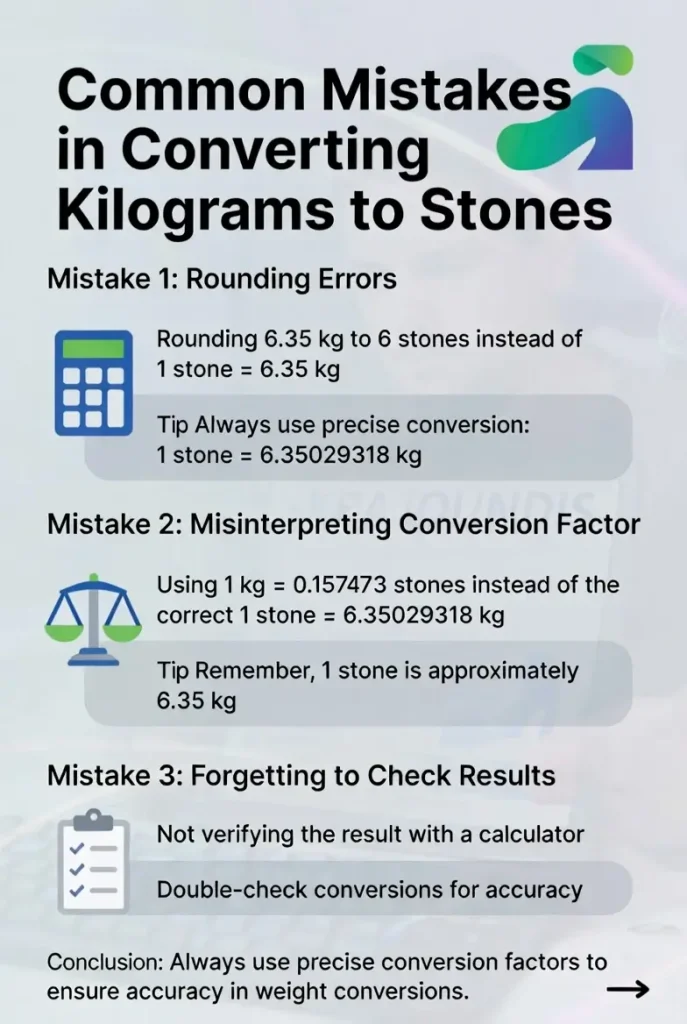
The single most foundational error people make is using an imprecise conversion factor. The exact, internationally defined value is:
1 stone = 6.35029 kg
Many people round this down to simply 6.35 or even 6.3. For a single conversion this might seem harmless, but the error compounds rapidly when you are working through multi-step calculations or tracking changes over time.
How the Error Accumulates
Example — Cumulative Error at 15 Stone
Using 6.35: 15 x 6.35 = 95.25 kg
Using 6.35029: 15 x 6.35029 = 95.254 kg
Difference: 0.004 kg — small but cumulative over months of tracking
✓ How to Avoid It
Always use the full value of 6.35029 in your calculations. Save it as a reference note on your phone or bookmark a verified converter tool. Do not rely on rounded approximations you have memorised.
Mistake 2
Reversing the Formula
This is arguably the most common error of all, and it is easy to make under pressure or in a hurry. People forget which direction the formula runs and either multiply when they should divide, or divide when they should multiply.
Kg to Stone: weight in kg / 6.35029
Stone to Kg: weight in stone x 6.35029
A Real-World Example
Example — 80 kg and 12 Stone
Correct (kg to stone): 80 / 6.35029 = 12.598 stone (approx. 12 st 8.4 lb)
Reversed (wrong): 80 x 6.35029 = 508.02 — clearly impossible
Correct (stone to kg): 12 x 6.35029 = 76.20 kg
Reversed (wrong): 12 / 6.35029 = 1.89 — clearly wrong, but only if you notice
✓ How to Avoid It
Build a simple mental sanity check: one stone is slightly more than 6 kg, so a person weighing 12 stone should convert to roughly 76 kg. If your answer is wildly outside that ballpark, you have almost certainly reversed the formula.
Mistake 3
Rounding Too Early in the Process
Rounding is inevitable at the end of a calculation — nobody walks around weighing 76.2034 kg. The problem arises when people round intermediate figures rather than the final result. Each premature rounding introduces a small error that gets amplified by subsequent operations.
Why This Is Particularly Dangerous for BMI
If you round your converted weight to the nearest kilogram before squaring your height and performing the BMI division, the resulting figure can shift by 0.1 to 0.3 points — enough in some cases to place you in a different clinical category. For calorie planning, a 1 kg error in estimated body weight can translate to a 10 to 15 calorie error in your daily maintenance target, accumulating to over 400 calories a month.
Example — Early vs. Late Rounding (Height 1.75 m)
Early rounding: 13.4 st x 6.35029 = 85.09 rounded to 85 kg → BMI = 85 / 3.0625 = 27.76
Late rounding: 85.09 / 3.0625 = 27.79 → then round
The gap widens further when multiple conversion steps are involved.
✓ How to Avoid It
Treat rounding as the very last step. Carry full decimal precision through every intermediate calculation and only round once you have your final answer.
Mistake 4
Confusing Stone with Pounds
One of the most misunderstood aspects of the imperial weight system is that stone and pounds are not decimally related. A weight expressed as “12 stone 8 pounds” is not 12.8 stone — it is 12 stone plus 8 of the 14 pounds that make up one full stone.
1 stone = 14 pounds
12 st 8 lb = 12 + (8 / 14) = 12.571 stone
This is NOT the same as 12.8 stone
The Proper Conversion Method
To convert a combined stone-and-pounds figure to kilograms correctly, first convert everything to pounds by multiplying the stone value by 14 and adding the remaining pounds. Then convert the total pounds to kilograms using the factor 0.453592 kg per pound.
Example — 12 st 8 lb to kg
Step 1: (12 x 14) + 8 = 176 lbs total
Step 2: 176 x 0.453592 = 79.83 kg
Incorrect shortcut: 12.8 x 6.35029 = 81.28 kg — an error of nearly 1.5 kg
✓ How to Avoid It
Never treat the pound component as a decimal of a stone. Always convert the pounds element separately by dividing by 14 to get the decimal fraction before performing the final conversion. This error is especially common in gym environments where people quickly note down bodyweight without applying rigorous conversion.
Mistake 5
Guessing Instead of Calculating
A surprisingly widespread shortcut is the approximation that “1 stone is roughly 7 kg.” This figure has taken hold in casual conversation and even appears in some older fitness resources. It is simply wrong — and by a significant margin.
1 stone = 6.35029 kg — not 7 kg
Error per stone: 0.65 kg
Error at 15 stone: 0.65 x 15 = 9.75 kg off
Why This Matters Beyond the Gym
In casual settings, being 2 to 3 kg out may feel inconsequential. But if a healthcare provider or pharmacist is working from a patient-reported weight that has been approximated using the “7 kg per stone” shortcut, the consequences can extend to medication dosing, anaesthetic calculations, or nutritional supplementation. In professional or medical contexts, there is simply no justification for guessing.
Warning — Risk in Professional Contexts
Some medications and clinical interventions are dosed by body weight. An approximation error of several kilograms is not a rounding issue — it is a clinical risk. Always use the exact conversion factor.
✓ How to Avoid It
Use a verified calculator or apply the exact conversion factor. If you genuinely need a rough mental estimate, 6.35 is far more accurate than 7 and only marginally harder to remember.
Mistake 6
Calculating BMI Without Converting to Kg First
The BMI formula is defined as:
BMI = weight (kg) / height (m)²
It requires weight expressed specifically in kilograms. Plugging in a stone value directly — without first converting — produces a number that is mathematically coherent but physiologically meaningless. It will not trigger an error message; it will simply give you a completely wrong BMI.
Step-by-Step Correct Process
Example — 11 stone 4 lb, height 1.68 m
Step 1: Convert to total pounds: (11 x 14) + 4 = 158 lbs
Step 2: Convert to kg: 158 x 0.453592 = 71.67 kg
Step 3: Square the height: 1.68² = 2.8224
Step 4: BMI = 71.67 / 2.8224 = 25.39 (just into the overweight range)
Wrong approach: Using 11.29 stone directly gives a BMI of approximately 4.0 — a meaningless figure.
The NHS recommends using its own online BMI calculator, which handles unit conversion internally when you select your preferred input format. If you are performing the calculation manually, converting to kilograms first is non-negotiable.
✓ How to Avoid It
Make converting to kilograms a mandatory first step any time you approach a BMI calculation manually. Write it into your process as a checklist item — convert, then calculate.
Practical Tips for Accurate Kg to Stone Conversion
Knowing where errors occur is only half the battle. The other half is building habits and using tools that make accurate conversion automatic rather than effortful.
Keep Full Decimal Precision
Always carry 6.35029 through every calculation and only round at the very final step.
Use Verified Conversion Tools
Rely on reputable online converters or apps that apply the internationally defined factor. Avoid ad-hoc tools with no stated accuracy.
Double-Check in Spreadsheets
If you track weight in a spreadsheet, build the conversion formula in once and hard-code 6.35029 into your formula cell to prevent drift.
Save a Quick-Reference Chart
A pre-calculated table covering common stone values gives you an instant sanity check without manual arithmetic every time.
Quick-Reference Conversion Chart (65.5 kg – 85.5 kg)
| Kilograms (kg) | Stone (decimal) | Stone & Pounds |
|---|---|---|
| 65.5 kg | 10.314 st | 10 st 4.4 lb |
| 66.5 kg | 10.472 st | 10 st 6.6 lb |
| 67.5 kg | 10.629 st | 10 st 8.8 lb |
| 68.5 kg | 10.787 st | 10 st 11.0 lb |
| 69.5 kg | 10.944 st | 10 st 13.2 lb |
| 70.5 kg | 11.102 st | 11 st 1.4 lb |
| 71.5 kg | 11.259 st | 11 st 3.6 lb |
| 72.5 kg | 11.417 st | 11 st 5.8 lb |
| 73.5 kg | 11.574 st | 11 st 8.0 lb |
| 74.5 kg | 11.732 st | 11 st 10.2 lb |
| 75.5 kg | 11.889 st | 11 st 12.4 lb |
| 76.5 kg | 12.047 st | 12 st 0.7 lb |
| 77.5 kg | 12.204 st | 12 st 2.9 lb |
| 78.5 kg | 12.362 st | 12 st 5.1 lb |
| 79.5 kg | 12.519 st | 12 st 7.3 lb |
| 80.5 kg | 12.677 st | 12 st 9.5 lb |
| 81.5 kg | 12.834 st | 12 st 11.7 lb |
| 82.5 kg | 12.992 st | 12 st 13.9 lb |
| 83.5 kg | 13.149 st | 13 st 2.1 lb |
| 84.5 kg | 13.306 st | 13 st 4.3 lb |
| 85.5 kg | 13.464 st | 13 st 6.5 lb |
Conclusion: Precision Is Not Pedantry
Weight conversion might feel like a trivial calculation, but as this guide has shown, the mistakes people make are consistent, predictable, and consequential. Whether you are using the wrong conversion factor, reversing the formula, treating pound values as decimal stone, or skipping the conversion step before a BMI calculation entirely, each of these errors carries a real-world cost.
To summarize the key lessons: always use 6.35029 as your conversion factor; divide kilograms by 6.35029 to get stone; multiply stone by 6.35029 to get kilograms; convert stone-and-pound weights fully before applying any formula; never treat the pound element as a decimal fraction of a stone; round only at the final step; and resist the temptation to approximate with the “7 kg per stone” myth.
The good news is that none of these mistakes require advanced mathematics to avoid — they just require awareness and the right habits. Whether you are calculating BMI for a clinical appointment, tracking fat loss over a 12-week programme, or simply curious about your weight in a different unit, accuracy is not pedantry. It is the foundation of meaningful data.
If you want to skip the manual arithmetic entirely, use a reliable kg to stone converter that applies the exact conversion factor and handles the stone-and-pounds distinction automatically. Getting the numbers right from the start means every health decision you build on them will be on solid ground.
What is 14.5 kg to stone ?
14.5 kg equals 2.28 stone, rounded to two decimal places.