Weight Calculator –Convert Stone to KG Instantly
Weight is one of the most commonly measured aspects of daily life, yet the units used to express it vary significantly from one country to another. A person born and raised in the United Kingdom may express their body weight in stone, while someone in continental Europe or a medical clinic almost anywhere in the world will default to kilograms. This mismatch creates a very real and everyday problem.
Whether you are reading a fitness article, visiting a foreign doctor, filling out an international health form, or simply trying to compare your weight with a friend overseas, you often need to convert from one unit to another quickly and without error. Doing this by hand requires knowing the exact conversion factor and applying it correctly — and even a small arithmetic mistake can lead to results that are noticeably off.
“A reliable weight calculator bridges the gap between measurement systems, eliminating confusion and delivering accurate results in seconds.”
A dedicated weight calculator solves this problem elegantly. It handles the arithmetic for you, applies the correct conversion factor every time, and presents results rounded to whatever level of precision you need. This is why weight calculators have become an essential everyday tool — not just for professionals, but for anyone navigating a world that uses multiple measurement systems simultaneously.
What Is Stone?
The stone is a unit of weight with a remarkably long history. It originated in medieval Britain, where merchants used actual stones of standardized weight to measure goods in markets. Different trades used different stone weights for centuries, which caused considerable confusion. Eventually, the British Parliament standardized the stone at exactly 14 pounds in 1835 through the Weights and Measures Act.
Today, the stone remains in common everyday use primarily in the United Kingdom and Ireland — particularly when people talk about body weight. A person who weighs “11 stone 4” means they weigh 11 stones and 4 additional pounds, a notation that still appears on bathroom scales, in health articles, and in casual conversation across the British Isles.
Quick Stone Facts
1 stone = 14 pounds (lb) · 1 stone = 6.35029 kilograms · Abbreviated as "st" · Common in UK, Ireland, and some Commonwealth countriesOutside of these regions, the stone is rarely understood or used. In science, medicine, and sport at an international level, kilograms are the universally accepted standard, which is precisely why converting from stone to kilograms is such a frequent need for people in or from stone-using cultures.
What Is a Kilogram?
The kilogram is the base unit of mass in the International System of Units, known globally as the SI system. It is the standard used by scientists, engineers, medical professionals, athletes, and everyday consumers across the vast majority of the world. Nearly every country except the United States, the UK for body weight, and a handful of others uses kilograms as the default measurement for body weight and general weighing purposes.
Historically, the kilogram was defined by a physical platinum-iridium cylinder kept in France, known as the International Prototype of the Kilogram. Since May 2019, it has been redefined using fundamental physical constants — specifically Planck’s constant — making it a truly universal and invariable measurement.
Quick Kilogram Facts
Abbreviated as "kg" · 1 kg = 1,000 grams · 1 kg ≈ 2.20462 pounds · The global standard in medicine, science, and sport · Used in nearly every country worldwideIn practical terms, knowing your weight in kilograms is essential for calculating medication dosages, BMI (Body Mass Index), nutritional requirements, sports performance metrics, and countless other health and fitness applications. It is the language of modern health and science.
Why Stone to KG Conversion Is Needed
The need to convert stone to kilograms arises in many real-life situations, and it is far more common than people might initially assume. Here are the most significant scenarios where this conversion becomes genuinely necessary.
Medical and healthcare settings almost universally use kilograms. When a British patient is prescribed medication, their dosage is typically calculated based on their weight in kilograms. A doctor in the UK, Europe, or anywhere else in the world will ask for weight in kg. Someone who only knows their weight in stone needs to convert before they can give an accurate answer or verify their prescription.
Fitness and sports environments present another common scenario. International gym equipment, weight training guides, diet plans, and calorie calculators almost all use kilograms. If you are following a global fitness programme, you need your weight in kg to apply the formulae correctly.
Travel and international communication further illustrate the need. Moving abroad, applying for visas, filling in forms for foreign insurance providers, or simply communicating with an international friend about health goals — all of these are moments when you need to translate your stone-based understanding of your own weight into kilograms that others can understand.
Kilograms = Stone × 6.35029The formula itself is straightforward, but remembering the exact conversion factor (6.35029) and applying it consistently without a calculator is where errors creep in. An online weight calculator ensures the right factor is applied every single time.
Conversion Examples
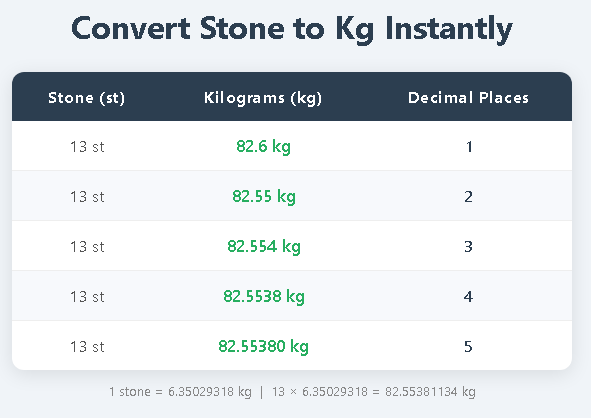
To make the conversion process tangible and easy to follow, here are two worked examples using real stone values, with results rounded to two decimal places.
Example One – 10.1 Stone to Kg
10.1 × 6.35029 = 64.138…
Rounded to 2 decimal places = 64.14 kg
Example Two – 8.2 Stone to Kg
8.2 × 6.35029 = 52.072…
Rounded to 2 decimal places = 52.07 kg
As these examples demonstrate, the arithmetic is simple in principle — multiply the stone value by 6.35029. However, the intermediate result often contains five or more decimal places. Deciding where to round, and doing so correctly, is where a calculator proves its value.
Rounding & Decimal Explanation
When converting stone to kilograms, the result is rarely a clean whole number. Understanding how rounding works helps you choose the right level of precision for your specific purpose.
Rounding to two decimal places means keeping only the first two digits after the decimal point, and then adjusting the last kept digit up or down depending on what follows it. The rule is simple: if the third decimal digit is 5 or more, you round up the second decimal digit. If it is 4 or less, you leave it as it is.
For everyday purposes such as tracking body weight, two decimal places is perfectly sufficient and is the standard used by most bathroom scales and health applications. For medical or scientific contexts, some professionals prefer results to three or four decimal places for greater precision.
The important thing to understand is that rounding is always an approximation. The more decimal places you keep, the closer your result is to the true mathematical answer. For personal weight tracking, 64.14 kg and 64.1379 kg are functionally identical — the difference is less than half a gram.
Conversion Table
The following table provides a ready reference for converting stone values in the range of 13.1 through 13.10 to kilograms, all results rounded to two decimal places. This range is commonly encountered in adult body weight discussions and is particularly useful for quick lookups without needing to perform any calculations yourself.
| Stone (st) | Kilograms (kg) |
|---|---|
| 13.1 st | 83.19 kg |
| 13.2 st | 83.82 kg |
| 13.3 st | 84.46 kg |
| 13.4 st | 85.09 kg |
| 13.5 st | 85.73 kg |
| 13.6 st | 86.36 kg |
| 13.7 st | 86.99 kg |
| 13.8 st | 87.63 kg |
| 13.9 st | 88.26 kg |
| 13.10 st | 88.90 kg |
Notice that the values increase by approximately 0.635 kg for each 0.1 stone increment — which makes sense, since one full stone equals 6.35029 kg, so one-tenth of a stone equals roughly 0.635 kg. This regularity makes the table easy to interpolate from if you need a value between two listed entries.
Why Use an Online Calculator
Given that the formula for converting stone to kilograms is not particularly complicated, one might wonder why an online calculator is necessary at all. The answer lies in the real-world costs of manual calculation errors and the genuine advantages that a well-designed digital tool provides.
- Manual calculation carries the risk of rounding errors. When you multiply 13.7 by 6.35029 in your head or even on paper, there are multiple points at which a mistake can enter — misremembering the conversion factor, miscalculating the product, or rounding at the wrong decimal place. In health-related contexts, even a small error can matter.
- An online calculator delivers instant, accurate results every time. It uses the exact conversion factor stored in its code and performs the multiplication precisely, then rounds to whatever number of decimal places you specify. There is no room for arithmetic slip-ups. What would take a minute or more with a pen and calculator is done in under a second.
- Multiple decimal precision options are available. Depending on whether you need a rough estimate or a clinically precise figure, a good online calculator lets you choose how many decimal places to display — whether that is zero for a round number, two for standard everyday use, or four for more precise professional purposes.
- No login, account, or download is required. You simply open the tool in your browser, type in your stone value, and get your answer. There is no registration process, no personal data collection, and no software installation. It is as friction-less as a tool can be.
- Accessible on any device. A well-built online weight calculator works equally well on a desktop computer, a tablet, or a smartphone — meaning you can look up a conversion anywhere, at any time, including at the gym, at the doctor’s office, or while traveling abroad.
“Manual calculation introduces human error. An online calculator eliminates it entirely — and does so without requiring a single login.”
In short, the combination of speed, accuracy, flexibility in precision, and complete ease of access makes an online weight calculator the obvious choice over manual arithmetic. It is a small but genuinely useful tool that saves time and prevents mistakes in situations where getting the number right actually matters.
What is 17.5 stone to kg ?
17.5 stone equals 111.13 kg, rounded to two decimal places.